
UTM tracking for clinic campaigns helps a marketing team identify which shared links bring visitors to the website. It is useful when a practice promotes the same page through email, social posts, partner websites or paid activity. The value comes from consistent naming and tested measurement, not from adding a long string to every link.
This guide explains a practical naming register, test routine and reporting approach. It includes fictional examples for a clinic campaign. UTM values describe marketing activity; they should not contain names, contact details or sensitive information about the person clicking.
Understand what a UTM link can show
A tagged link adds campaign parameters to a destination URL. If the measurement setup collects them, those values can help classify the visit. Google explains the parameters and reporting behaviour in its campaign URL guide.
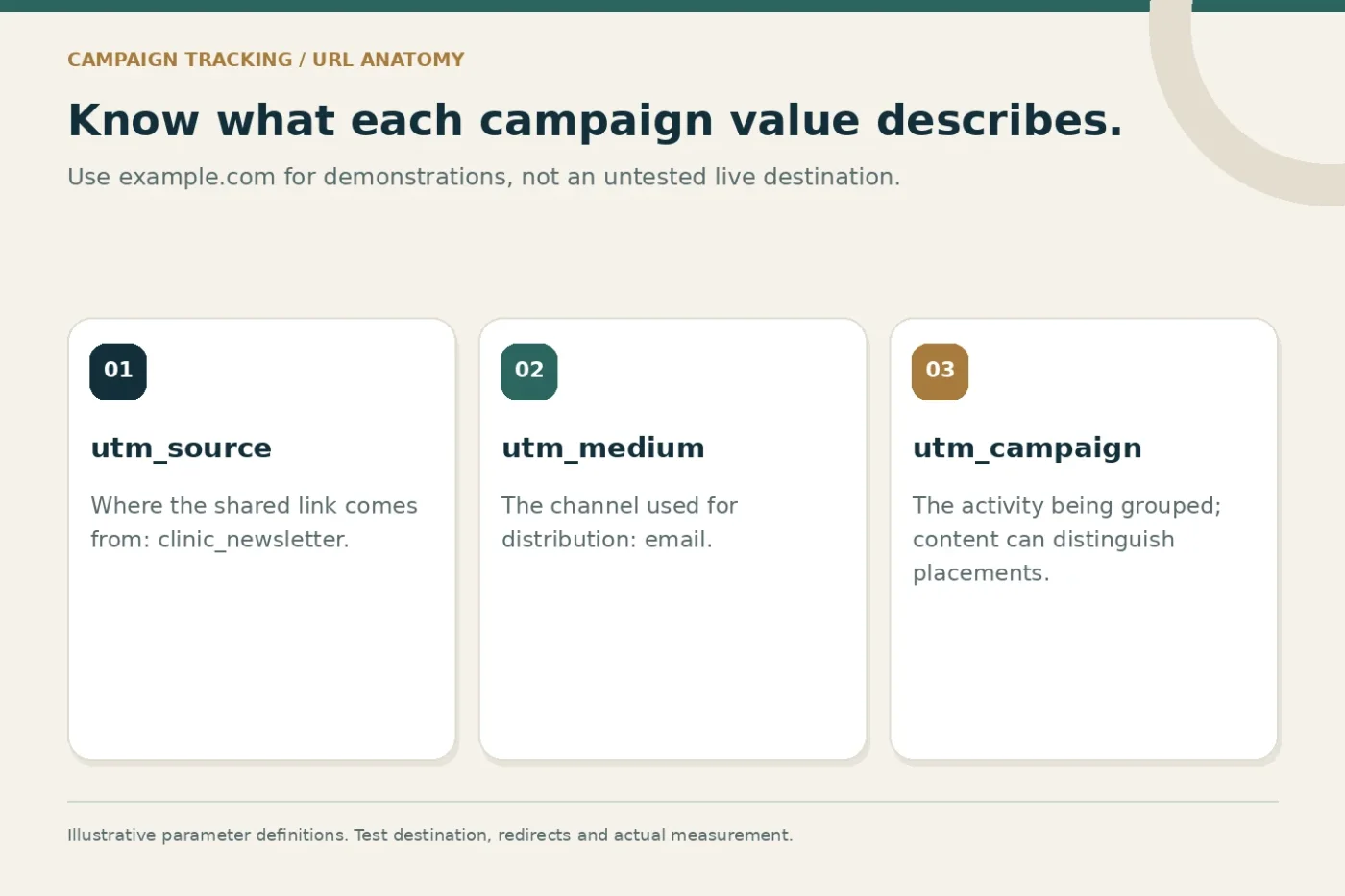
Three useful starting fields are source, medium and campaign. Source identifies where the link was shared; medium describes the channel; campaign groups the activity. An optional content value can distinguish creative versions. Google's guide recommends including source, medium and campaign when adding UTM parameters.
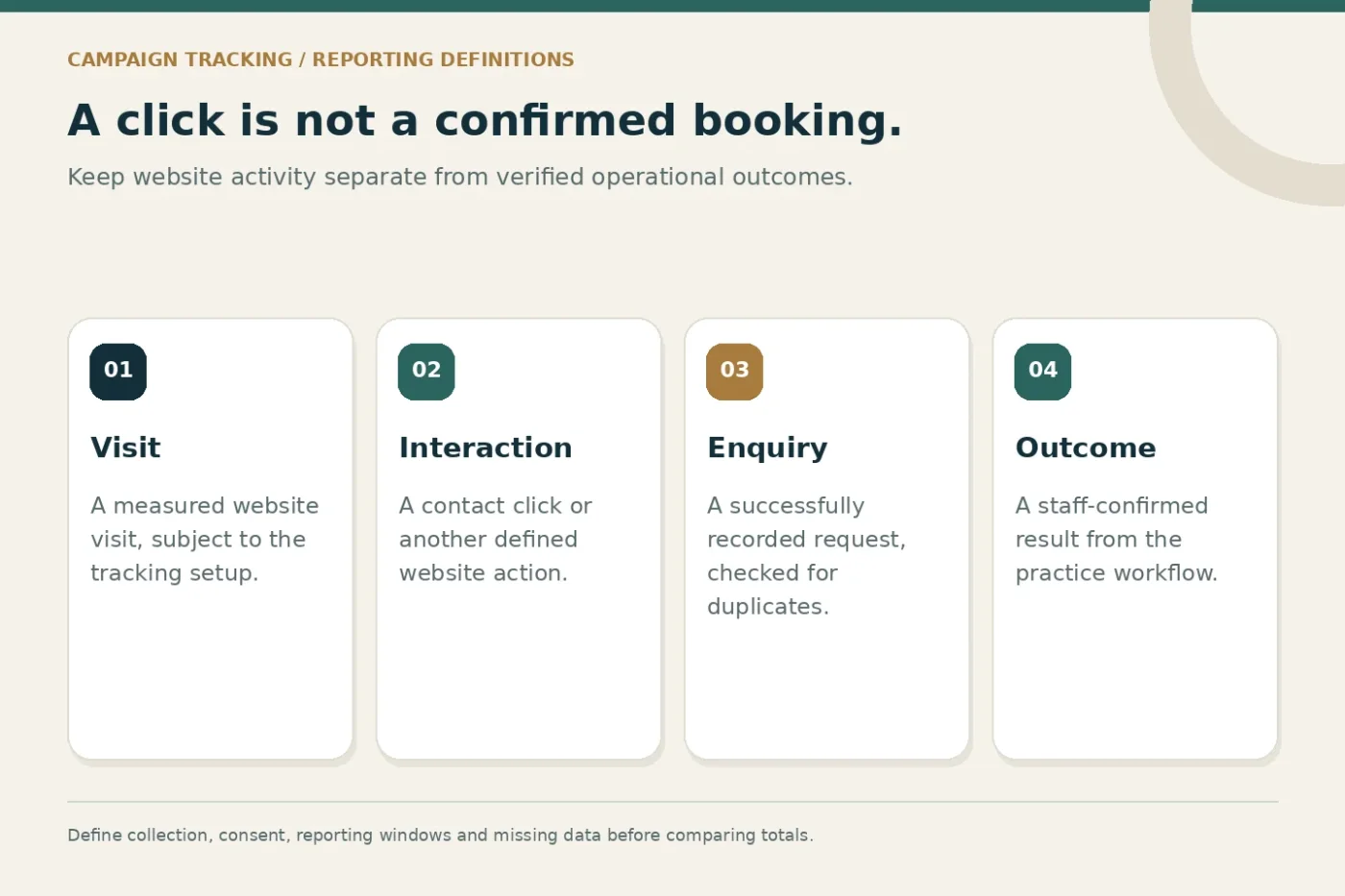
A tagged visit is not proof of an enquiry, and an enquiry is not proof of a confirmed appointment. Tracking can also be incomplete. Keep these limits visible when someone asks which campaign produced business outcomes.
Create a naming register before building links
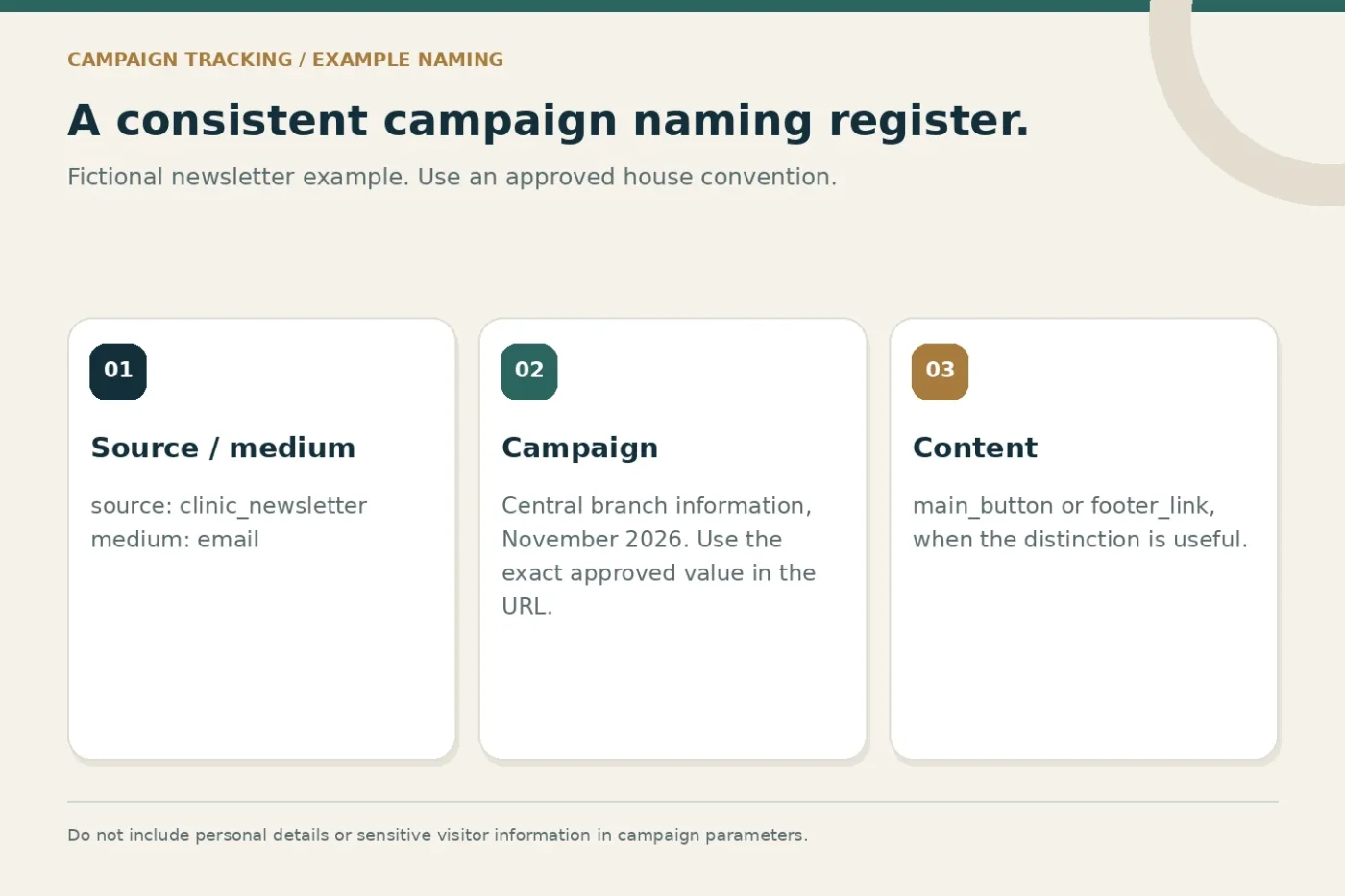
Agree a short list of allowed values. For example, use one source value for a particular email newsletter and one medium value for email. Avoid allowing different staff members to invent variations every week, because similar activity can become split across multiple reporting rows.
Choose a consistent case and separator convention. A practical house rule might be lowercase words separated by underscores. This is an internal operating choice, not a universal ranking requirement. Document it so an agency, receptionist and owner can generate comparable links.
Give the register an owner. Include the campaign purpose, destination, approved parameter values, creation date and intended placement. A shared register is especially helpful when several branches or outside partners distribute links for the same campaign.
Name the activity without including private information
Use campaign labels that describe the communication, such as a branch information update or an educational content series. Do not add a visitor's name, telephone number, email address or individual circumstances to a URL. URLs can be copied, shared and recorded in several systems.
Keep labels understandable to the people who will read the report. A code is acceptable if the register explains it, but a string of unexplained abbreviations makes later analysis difficult. Avoid labels that imply a result before one has been measured.
A branch identifier may be useful when it represents the public campaign destination. Check that the same identifier is used consistently in the website and reporting register. Do not use tracking labels as a substitute for showing clear branch information to the visitor.
Build one complete example
Imagine a fictional clinic sharing a general branch information page in its November newsletter. The destination is `https://example.com/locations/central`. A proposed convention could use source `clinic_newsletter`, medium `email`, campaign `central_branch_information_2026_11` and content `main_button`.
The resulting example is `https://example.com/locations/central?utm_source=clinic_newsletter&utm_medium=email&utm_campaign=central_branch_information_2026_11&utm_content=main_button`. This is a demonstration URL on a reserved example domain, not a live campaign or a claim about your current analytics setup.
If a second link in the same newsletter needs separate analysis, retain the shared campaign values and choose a distinct content label, such as `footer_link`. Only add that distinction if someone will use it. Extra detail creates maintenance work and should answer a real reporting question.
Keep internal navigation clean
Use campaign tags for the external activity you intend to identify. For ordinary navigation within your own website, prefer the normal internal destination and track the interaction through an appropriate event where needed. Adding campaign labels to every menu and service link makes the measurement design harder to interpret.
When several channels need the same landing page, maintain one useful page rather than publishing a separate duplicate for each tracking link. The query parameters identify the campaign variant; the underlying information can remain consistent. Ask the developer to verify the site's canonical and indexing behaviour.
Where an advertising platform already uses an integrated tagging method, review that setup before adding manual values. Do not overwrite existing campaign behaviour based on a generic checklist. The appropriate implementation depends on the platform, account links and reporting requirements.
A campaign link control process
- Define
Choose the campaign question and the destination.
- Name
Use approved source, medium and campaign values.
- Test
Check the link, consent flow and recorded visit.
- Review
Compare visits with separately verified enquiry outcomes.
Test the full journey before distribution
Open the final link on mobile and desktop. Confirm that it reaches the intended page, retains necessary parameters through any redirects and does not produce an error when an existing query string is present. A URL builder reduces typing mistakes but does not replace a journey test.
Check the site's measurement and consent arrangements with the person responsible for implementation. Test according to the consent choices and supported browser conditions. Do not infer that tracking works simply because the page opens or a tag identifier appears in source code.
Use a labelled test entry if you also need to verify an enquiry form. Confirm the admin record, routing and source handling without including private details in the campaign URL. Record the test date and remove or exclude test records through the agreed process.
Connect visits to enquiries with clear definitions
Decide what the team wants to measure after the visit. A contact button click, a successful form submission and a staff-qualified request answer different questions. Give each event a definition and confirm how it is collected before including it in a report.
Google's recommended events documentation includes `generate_lead` and later lead-stage events. Implementing an event name alone does not establish the truth of an operational outcome. A staff-confirmed booking needs a reliable source in the practice's process.
If campaign details are stored with a form submission, define how the system handles repeat visits, missing tags and later interactions. Do not claim that a last-click label explains every influence on a decision. Document the attribution convention alongside the report.
Make the report useful to the clinic owner
Start with a small set of questions. Which distributions brought visits? Which visits were followed by recorded requests? Which requests could staff contact and assess? Show missing data and keep advertising spend distinct from website activity where those sources have not been reconciled.
An illustrative newsletter report might show visits by main button and footer link, alongside separately recorded enquiries. A stronger click count for one placement does not prove that the wording alone caused the difference; position, audience and timing may also matter. Use the result to form a testable question.
Review naming problems before drawing conclusions. If one campaign appears under several spellings, fix the operating process and document any reporting grouping. Do not silently rewrite source data in a way that removes the audit trail.
Common questions
Do UTM parameters improve search rankings?
Their purpose in this workflow is campaign identification and reporting. Use clear public page content and sound technical implementation for search visibility; do not add tags as a ranking tactic.
Can a tagged link prove a confirmed booking?
No. It can support source reporting when measurement works, but the booking must be confirmed through a separate reliable process. Keep the two records conceptually distinct.
Explore campaign link and UTM tracking setup with an analytics and tracking audit if your reports are unclear. Share the channels you use to define a manageable measurement scope.