
Meta Ads lead quality for clinics cannot be judged from the number of forms submitted alone. A campaign may generate inexpensive requests while staff struggle with duplicate records, unreachable contacts or enquiries for a service the branch does not offer. The useful question is whether the campaign attracts relevant conversations that the practice can handle responsibly.
This guide explains a staff feedback framework for campaign planning, form design and review. It uses an illustrative example rather than client results. Platform features and eligibility can change, so the final setup should be checked in the advertising account before launch.
Define a relevant enquiry before choosing a campaign
Agree what the practice means by a relevant enquiry. The definition might include a genuine request about an available service, a suitable location and enough accurate contact information for the agreed response. It should not depend on assumptions about someone's personal health or ability to buy.
Separate relevance from readiness. Someone researching a service may have a legitimate question without being ready to request an appointment. If staff classify every early-stage conversation as poor quality, the report will confuse an educational need with an invalid record.
Write a short classification guide before the campaign begins. Include examples of a duplicate, an incorrect number, an unrelated request and a relevant enquiry. Decide who resolves unclear cases. A shared definition is more useful than asking each staff member to apply an unwritten personal standard.
Choose the enquiry route for the actual offer
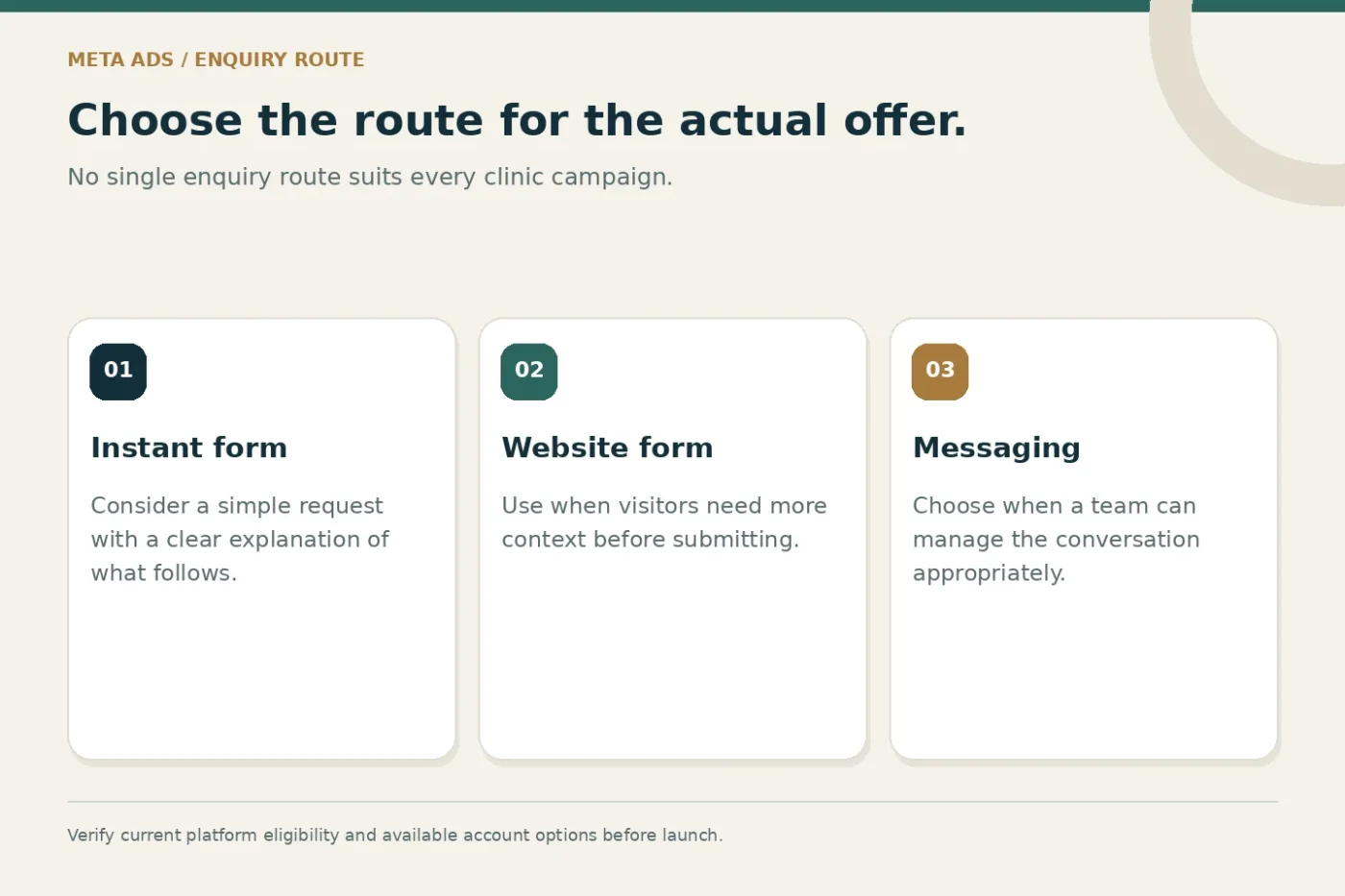
An instant form, website form and messaging route create different experiences. A simple request may suit a short form. A service that needs more explanation may benefit from a landing page. Messaging needs staff who can respond through an agreed process and keep the conversation appropriate.
Meta's lead-generation guide describes several lead-generation routes and form approaches. Treat the guide as background, then verify current options and restrictions in your account. Selecting a form type does not by itself establish that enquiries will be relevant.
Match the route to response capacity. If nobody can monitor messages during the advertised hours, a messaging campaign may create an expectation the practice cannot meet. Decide the response window and explain what happens after submission before publishing the advertisement.
Write advertising that sets the right expectation
The advertisement should make the offer understandable without overstating the outcome. Identify the practice, available service or information being offered, and the next action. Use approved factual wording and confirm any platform restrictions relevant to the proposed creative.
Avoid a mismatch between the advertisement and the destination. If the ad invites someone to ask about a specific branch, the form or landing page should retain that context. If fees require a conversation, do not present the form as an instant purchase or guaranteed appointment.
Review the creative with the team responsible for answering enquiries. Staff can often identify wording that will produce predictable confusion. For example, an invitation to request information needs a different response script from an invitation to book an already-defined appointment slot.
Ask enough to route the request, without building a questionnaire
A form should gather the information needed for the next step. For a general enquiry, that may mean contact details, the relevant branch and a broad service interest. Avoid collecting sensitive details in a marketing form when a separate appropriate process is available.
The W3C forms tutorial explains the value of necessary fields, clear labels and usable feedback. For a website form, test labels, validation and the success message on mobile. Make sure the stored record includes the selected service and source information where the implementation supports it.
Adding questions can create useful context, but each question needs a reason. If staff never use a field, reconsider it. If a field is repeatedly misunderstood, improve the wording before concluding that visitors are careless or that every request is low quality.
Build a small set of feedback statuses
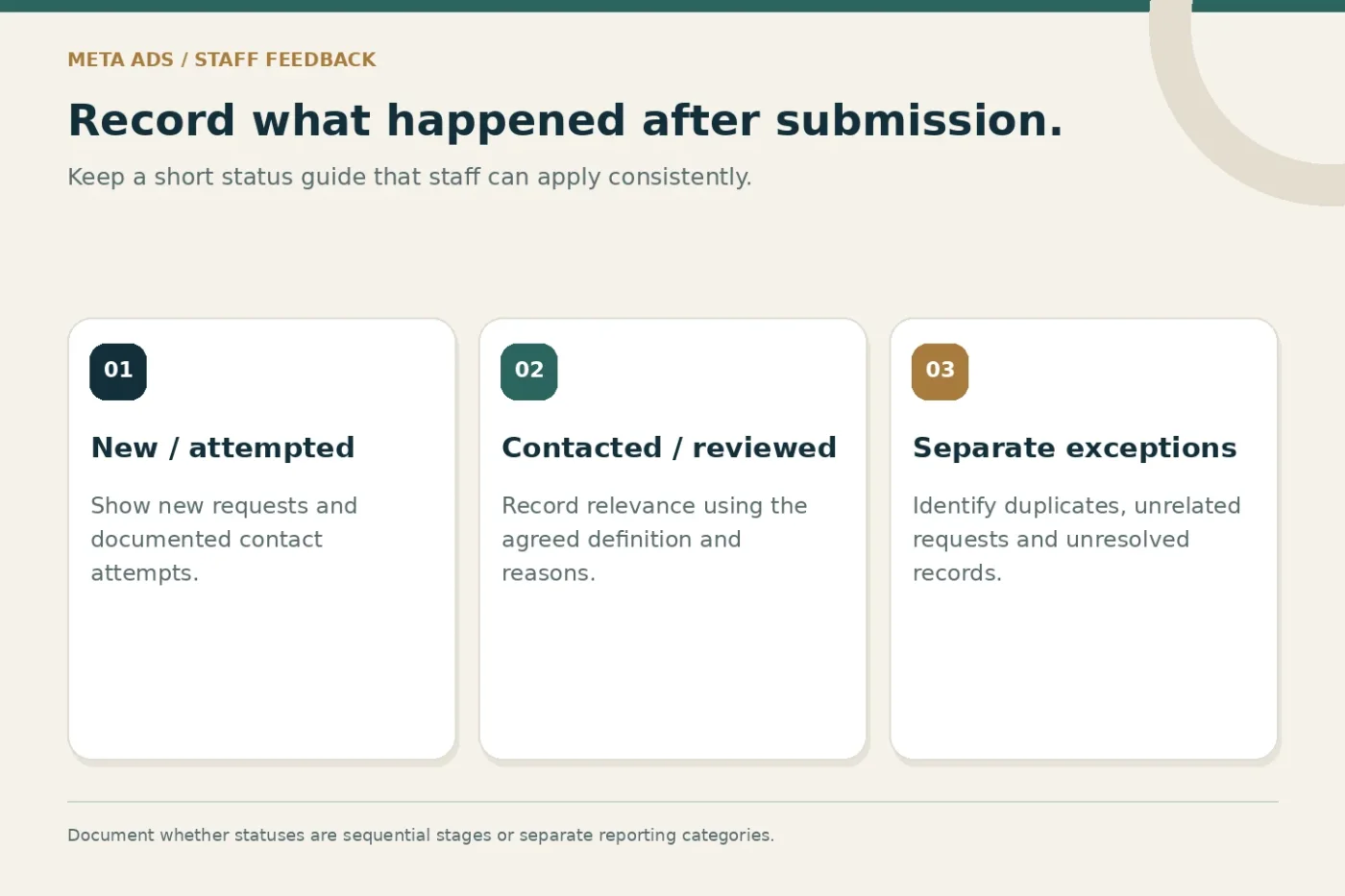
A practical starting set is: new, attempted contact, contacted, relevant, not relevant, duplicate and unable to contact. The practice may also need a separate operational outcome for a staff-confirmed booking. Document whether these are sequential stages or mutually exclusive reporting categories.
Record reasons where they support a decision. For example, not relevant might mean wrong location or unavailable service. Keep the list short enough for staff to use consistently. Do not ask the agency to infer sensitive personal information from free-text notes.
Set a review cutoff. An enquiry received yesterday may still be waiting for a scheduled follow-up, while an older record has had several attempts. Compare records with a similar opportunity for staff contact so the latest campaign is not penalised simply because its requests are newer.
A feedback loop for campaign decisions
- Define
Agree what relevant means and how staff record it.
- Explain
Align the advertisement, destination and next-step message.
- Respond
Route requests and record contact attempts consistently.
- Review
Compare reasons and change one clear problem at a time.
Read cost and quality together
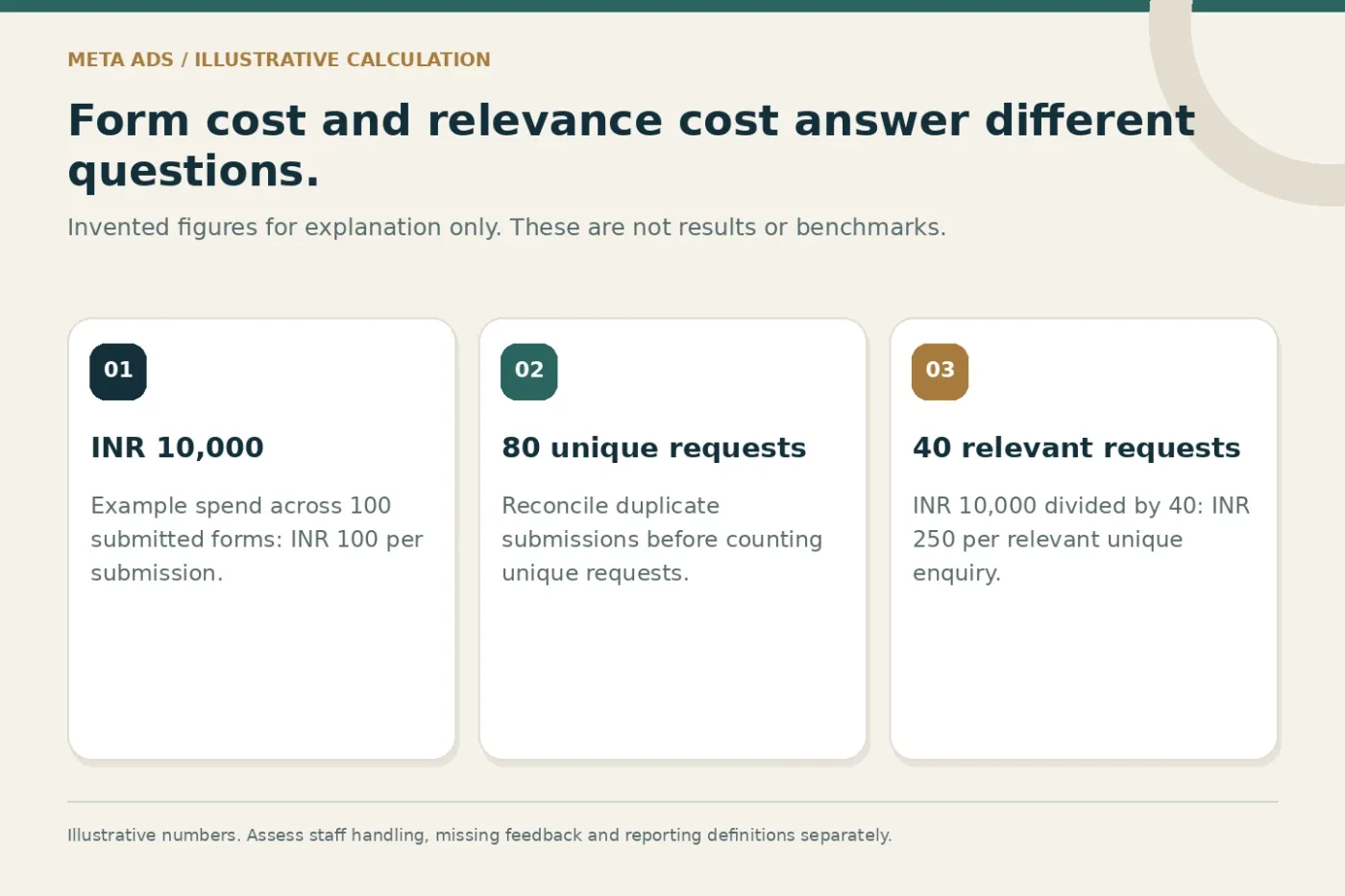
Cost per submitted form answers a narrow question: spend divided by recorded submissions. It does not tell you how many requests were unique, reachable or relevant. Show the denominator whenever you present a rate, and keep test records separate from live enquiries.
An illustrative campaign might spend INR 10,000 and record 100 submissions. After reconciliation, staff identify 80 unique requests; 40 meet the agreed relevance definition. Cost per submission is INR 100, while cost per relevant unique enquiry is INR 250. These are invented numbers to demonstrate the calculation, not a benchmark or expected result.
Do not interpret that example without the operational context. Slow follow-up, a routing fault or incomplete feedback can affect the recorded outcome. Report missing statuses rather than silently classifying them as failures. Review campaign setup and staff handling together before assigning a cause.
Turn the review into a specific change
If requests repeatedly concern the wrong branch, review location wording and routing. If people misunderstand what the form provides, revise the offer and confirmation message. If duplicate records inflate volume, investigate the integration before replacing the creative.
Keep a change log with the date, reason and expected observation. Avoid changing the offer, form, audience approach and follow-up script simultaneously when you need to understand which change helped. Set a review period appropriate to volume rather than declaring a winner from a few requests.
The useful agency deliverable is a short decision record: what happened, what remains uncertain, what will change and how it will be checked. This is more actionable than a dashboard containing only impressions, clicks and form counts.
Agree responsibilities before the campaign starts
The practice should approve factual service information, identify the response team and confirm operating hours. The agency's scope might include campaign setup, creative preparation, tracking checks and reporting. Define these responsibilities in writing, including advertising spend and any integration costs.
Discuss Meta Ads management with Meta lead ads to CRM integration if requests need structured routing. Neither service should be assumed to include reception staffing or a booking system unless the proposal states it.
Common questions
Are lead forms always the best option?
No single route fits every offer. Choose according to the explanation required, current platform eligibility, visitor expectations and the team's ability to respond. Evaluate relevance after a defined follow-up opportunity.
Does a cheaper enquiry mean a better campaign?
Not necessarily. Compare unique, relevant requests and documented operational outcomes alongside spend. A lower form cost can coexist with more duplicates or less relevant interest.
Discuss your service, branch and follow-up process before choosing the campaign route. A clear operating brief gives the advertising work a more useful starting point.