
Healthcare brand positioning gives a clinic a practical basis for deciding what to say, what to show and how to present its services. It is more useful than choosing an attractive logo in isolation. A clear position connects the practice's verified strengths with the information its intended audience needs before making an enquiry.
This guide explains how to prepare a positioning brief that can guide website copy, visual identity and communication. The examples are fictional planning scenarios, not claims about completed Doctor Promotion projects. The aim is a working document that helps the practice and creative team make consistent decisions.
Begin with facts the practice can stand behind
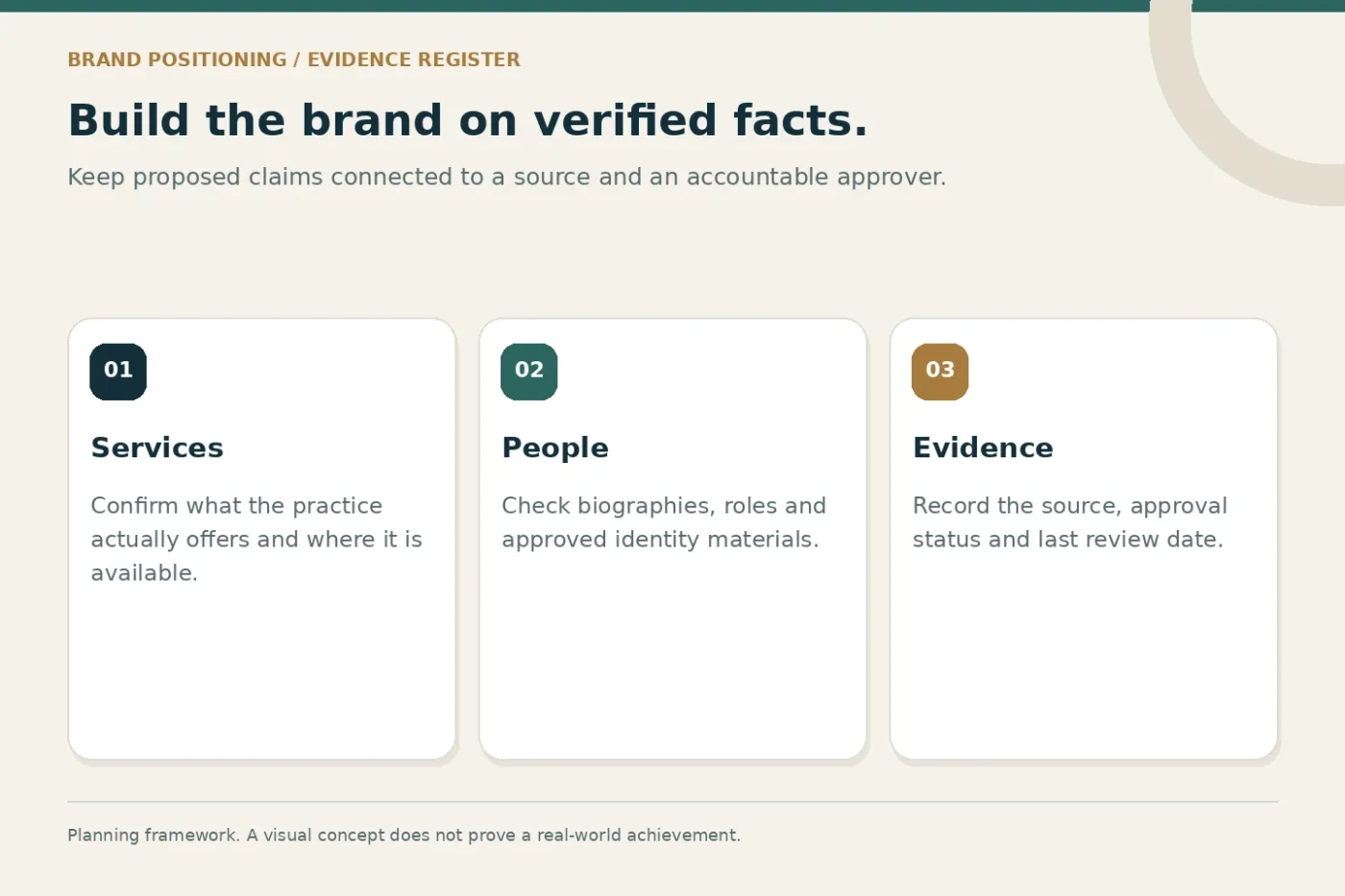
List the services actually available, the people authorised to provide them, the locations and the operating arrangements. Confirm which facts are current and who can approve them. A brand brief built on inaccurate service information will create problems even if the finished design looks polished.
Separate evidence from ambition. An ambition to become a recognised local practice can guide future work, but it should not appear as an established achievement. Similarly, a planned facility should not be described as available until the practice confirms it is operating.
Create a short evidence register. For each proposed claim, note the source, owner and approval status. That might be a verified biography, a current facility photograph or an approved description of the enquiry process. Keep material awaiting confirmation out of public copy.
Define the audience by its information needs
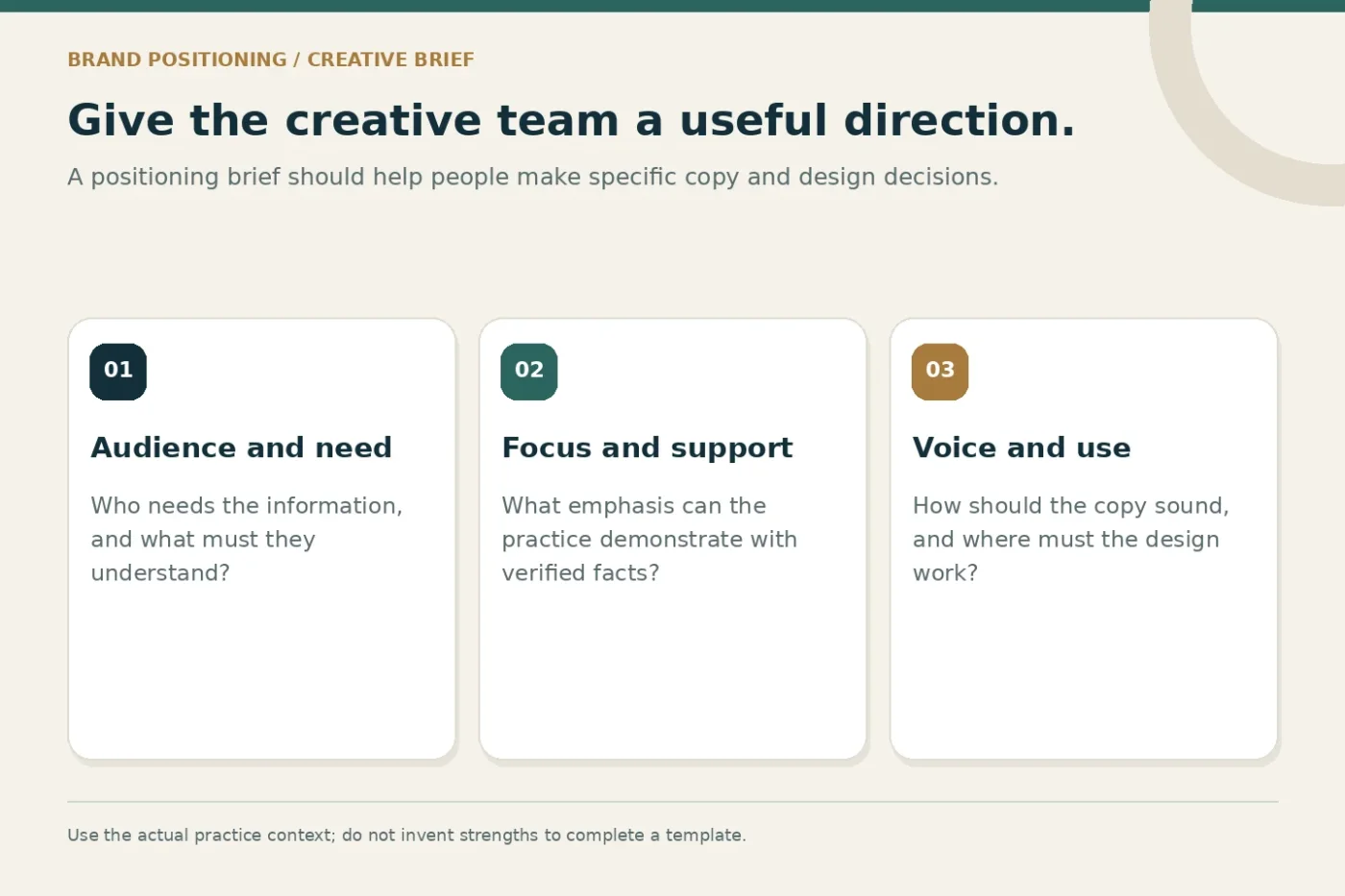
Avoid defining an audience only by age, income or an advertising platform's targeting options. Ask what someone needs to understand when considering the practice: the services offered, where to find it, which clinician is relevant and how the next conversation works.
Consider different journeys without inventing personal details. Someone discovering the practice for the first time may need orientation. A person referred by another professional may be checking credentials or location. An existing visitor may simply need accurate hours and a contact route.
These differences influence page order and wording. A homepage should introduce the practice clearly, while a specific service page can address a narrower question. The brand should help visitors recognise a coherent organisation across those journeys rather than repeat the same slogan everywhere.
Choose a meaningful emphasis
A positioning emphasis should be specific enough to guide choices and modest enough to support with facts. Examples might include clear service explanations, convenient branch information or a consistent experience across a growing practice. These are areas the team can demonstrate through its communication and operations.
Avoid building the entire position around words such as best, premium or trusted. Those words need context and evidence; they do not explain what the practice actually does differently. Ask what a visitor would notice if the proposed positioning were implemented well.
For example, a practice choosing clear communication as its emphasis could prioritise readable service pages, transparent enquiry expectations and consistent reception messages. The position becomes visible in the experience, rather than existing only as a statement in a brand presentation.
Write a positioning brief the designer can use
A useful brief contains the practice context, intended audience, selected emphasis, supporting evidence and practical constraints. Add a tone description with examples. Clear and reassuring might mean short explanations and direct next steps, rather than vague promises or elaborate terminology.
Include what should remain consistent: the approved business name, how clinician names are written, verified contact information and any existing visual assets that must be preserved. Record where different branches legitimately need different details.
Describe the decisions the brief must support. These could include a website opening statement, an identity refresh, a service brochure or a social media template set. A focused deliverable list helps the creative team distinguish strategic decisions from optional design variations.
Translate the position into useful website copy
Begin with a direct explanation of the practice, not a line that could describe any business. Follow it with confirmed service information, relevant people and location details. A visitor should understand the subject before being asked to interpret an abstract brand idea.
Use headings that explain what each section contains. Replace a general heading such as excellence in every detail with a heading that introduces actual facilities, services or practical information. The aim is clarity without making every sentence sound identical.
Google's people-first content guidance encourages material that benefits its intended audience. Apply that principle by answering real visitor questions and showing who is responsible for the information. A brand voice should support useful content rather than hide a lack of substance.
Make the visual direction relevant
Choose a visual direction that fits the practice's real setting and communication needs. Colour, typography and photography should work across a mobile website, a small social post and printed material. A beautiful desktop presentation is insufficient if the same system becomes unreadable on a phone.
A luxury appearance can come from restrained spacing, strong hierarchy and careful image selection. It does not require heavy decoration in every section. Check that the design leaves enough room for practical information and supports comfortable reading.
Use actual team or premises photographs only with appropriate permission. Keep illustrative imagery separate from evidence of real work. The W3C image tutorial explains that text alternatives should reflect an image's information or function; write alt text for the final asset rather than filling it with keywords.
A positioning-to-delivery framework
- Verify
Gather approved facts and evidence about the practice.
- Focus
Choose an audience need and a supportable emphasis.
- Express
Translate the brief into copy, design and contact journeys.
- Check
Review consistency across real public touchpoints.
An illustrative clinic positioning example
Imagine a fictional two-clinician practice whose website contains inconsistent biographies, generic imagery and several different descriptions of the same service. The owner wants the brand to feel more considered, but the immediate problem is that visitors cannot form a clear picture of the practice.
A useful first brief could prioritise verified people, understandable service information and an organised enquiry journey. The design direction might use a restrained palette and approved portraits, while the copy explains the practice in plain language. This is a proposed approach, not an expected commercial result.
The first release could cover the homepage, two biography templates, a service-page pattern and a concise reception message guide. Limiting the initial scope makes it easier to review whether the positioning is visible before extending the system to every channel.
Agree the outputs and approval process
Ask for deliverables that can be reviewed independently: an evidence summary, a positioning brief, sample copy and representative design applications. Clarify whether logo creation, brand guidelines, photography and website implementation are included or quoted separately.
Appoint one person to consolidate feedback. Conflicting comments from several channels can turn a focused brief into a collection of preferences. Record the reason for important decisions so a later reviewer understands why a phrase, colour or layout was selected.
A written proposal should also explain revision rounds, source-file handover and responsibility for approving factual material. Discuss healthcare brand strategy and positioning alongside healthcare brand guidelines design when the practice needs both direction and a reusable system.
Review whether the position is being applied
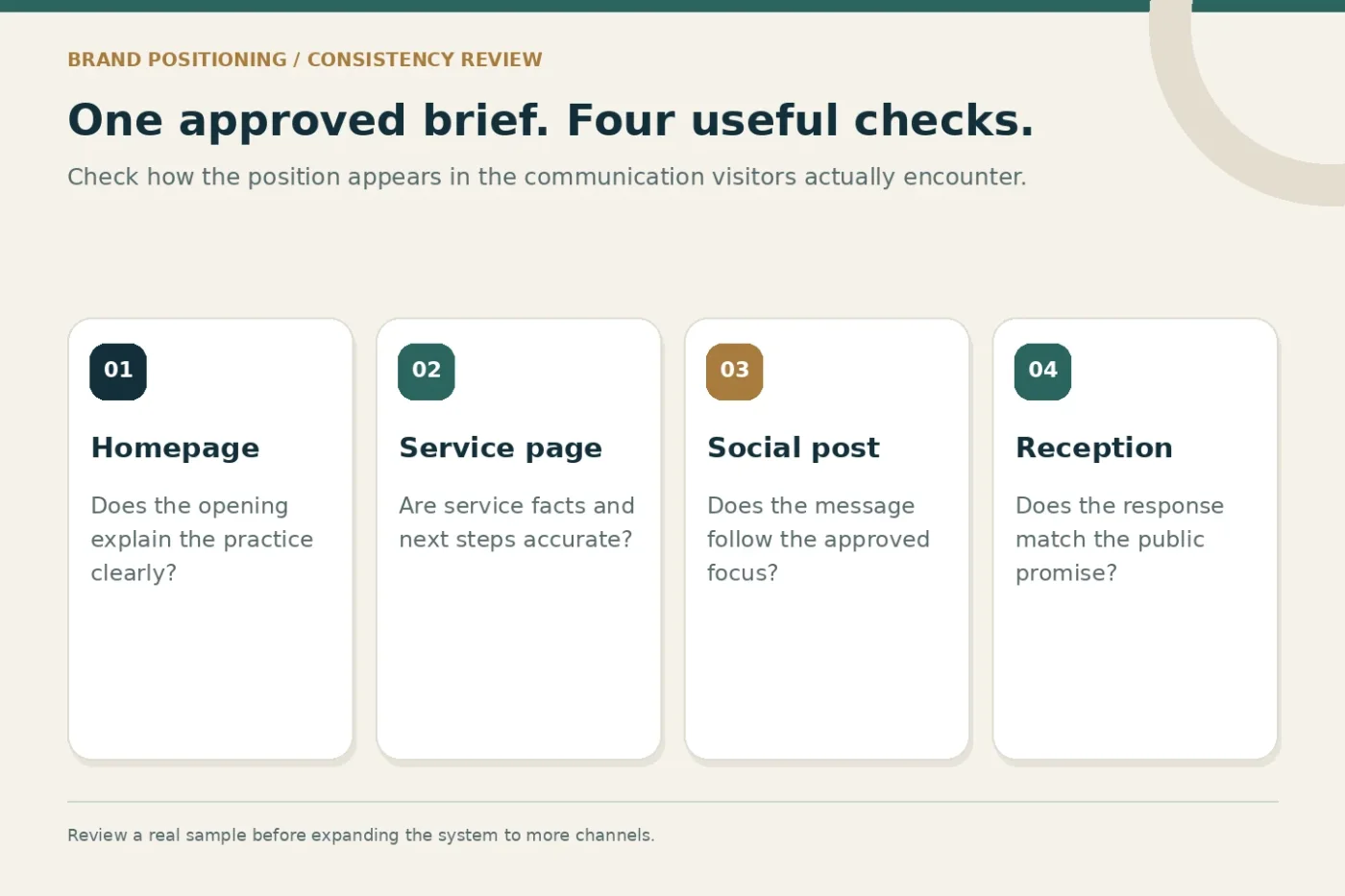
After launch, inspect a small sample of touchpoints: the homepage, one service page, a social post and a reception response. Check whether they communicate the same verified facts and next steps. Correct inconsistencies before adding more channels.
Do not treat compliments about the visual design as the only measure of success. Also review whether visitors find the right information and whether staff can use the approved materials without improvising. These observations can reveal practical improvements even when attribution data is limited.
Common questions
Do we need a new logo to improve positioning?
Not always. The main problem may be inconsistent information, unclear copy or an incomplete visitor journey. Confirm the problem before commissioning a complete identity replacement.
Can a new practice describe itself confidently?
Yes, by explaining its actual services, people and arrangements clearly. Confidence does not require invented achievements, borrowed case studies or unsupported superlatives.
Share your current website and brand materials to discuss a brief grounded in the practice you operate today.