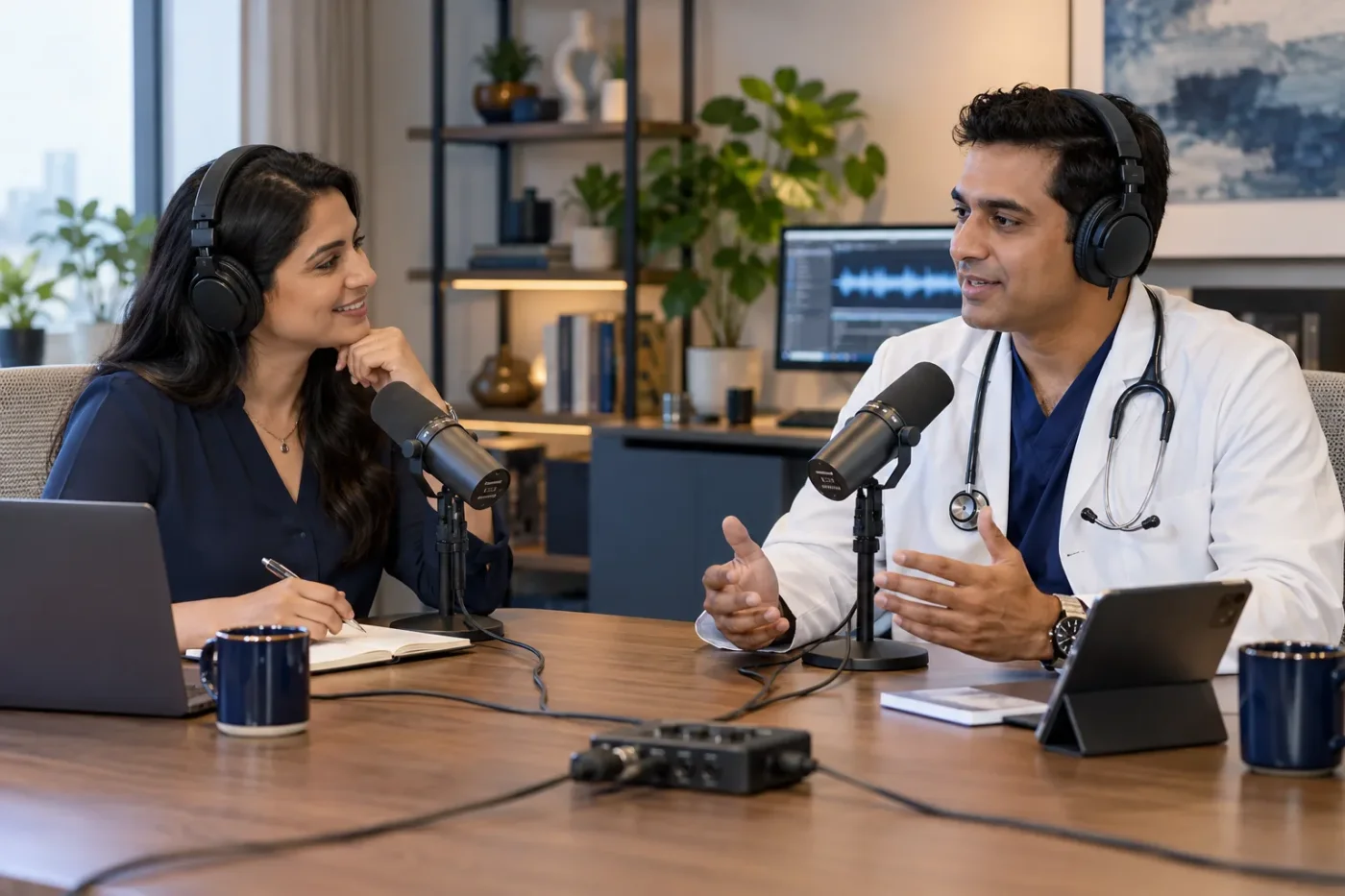
Doctor podcast planning starts with a useful conversation, not a microphone purchase. A recording can sound polished while leaving the listener unsure what the episode was meant to explain. A clear audience, focused question and responsible review process give the production team a stronger foundation than a list of broad topics.
This guide covers the editorial and production brief for a professional audio conversation. It goes beyond planning a short educational video by considering the longer listening experience, host preparation and supporting material. Doctor Promotion can use the brief to connect a doctor's expertise with a format that respects the listener's time.
Define the listener and the question
Choose a specific audience for the episode. A discussion for practice owners has different assumptions from a general educational conversation for the public. Do not begin with the idea that everyone interested in healthcare is one audience.
Write the main question in ordinary language. It should be narrow enough to explore with examples and follow-up questions. A broad theme such as “everything about healthcare” makes it difficult for the host to prepare and for the listener to understand what the episode offers before pressing play.
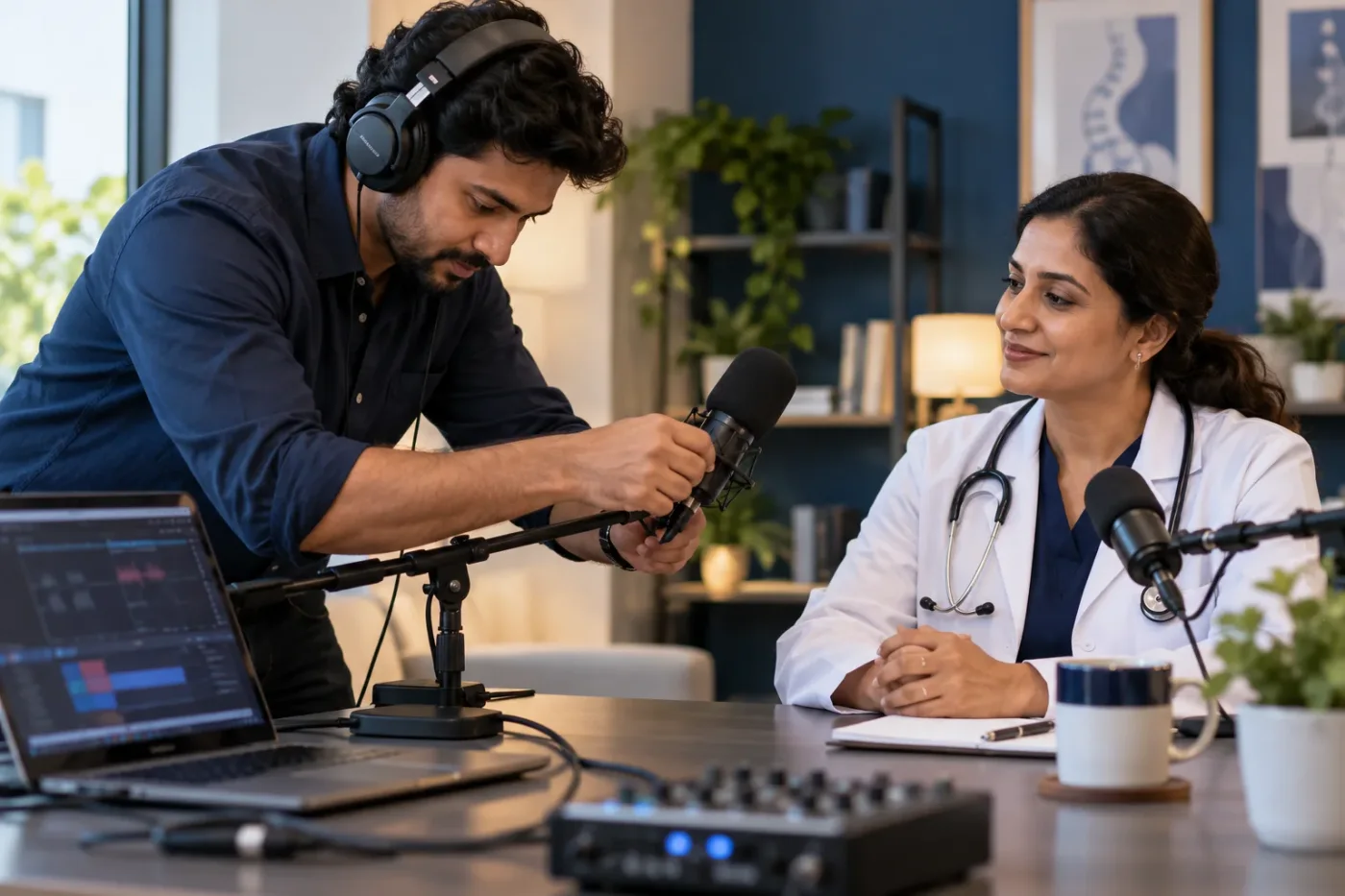
Decide what the episode will not cover
Set boundaries around the conversation. A public educational recording should not quietly become an individual consultation or a place to disclose identifiable personal experiences without an appropriate basis. Give the host a route for redirecting questions that do not belong in the format.
Record the intended scope in the guest brief. This is useful even when the guest and host already know each other. Clear boundaries reduce the chance that an unexpected question produces an answer the team later struggles to edit responsibly or explain out of context.
Prepare a conversation outline
Build a short progression: introduce the question, establish essential context, explore the main points and close with what the listener should understand. Use prompts rather than a script for every word unless the format requires a tightly written presentation.
Leave room for clarification. A host should be able to ask what a term means or request an example when an answer becomes abstract. Avoid treating a list of prepared questions as a checklist that must be completed even when the most useful explanation emerges from a thoughtful follow-up.
Confirm how the guest will be introduced
Verify the guest's name, role and relevant credentials. Keep the introduction proportional to the episode and avoid unsupported superlatives. A listener needs to understand why this person is contributing, not hear an inflated biography that obscures the question.
Ask the guest to approve factual identity details before recording. Clarify which organisation they are representing and whether any relationship is relevant to the discussion. Do not improvise an endorsement or affiliation because it makes the introduction sound more impressive. Preserve accurate details in the episode notes as well.

Plan examples that can be shared
Use examples that explain a principle without exposing private information. Fictional or composite situations should be described honestly. Do not present a hypothetical story as a documented outcome achieved by the guest or the production agency.
Ask the reviewer to identify claims that need checking and any material that should not appear in the final episode. A vivid anecdote is not automatically suitable for public use. The production team needs enough context to preserve the point without making the example more specific or certain than the speaker intended.
Rehearse the sound and setting
Choose a quiet environment and test the actual microphones, headphones and recording arrangement. Listen to a short sample rather than relying only on a visible level indicator. Background noise, echo and handling sounds can make a long conversation tiring to follow.
Check how remote guests will join and what happens if their connection fails. Agree who starts the recording and confirms that it is working. A simple rehearsal can expose a practical problem before the guest invests time in the full discussion or assumes a backup exists when none was arranged.
Give the editor a factual brief
Identify the main question, intended audience and passages that require particular care. Editing can improve flow, but it should not reverse a qualification or combine answers in a way that creates a new claim.
Use timestamps when requesting changes. Keep a record of the cut reviewed by the guest or authorised editor. If new content is inserted later, assess whether the previous review still covers it. The final release should have a clear owner rather than depending on several people assuming someone else approved the latest file.

Prepare notes that help listeners return
Write a concise episode summary, verified guest introduction and links to relevant supporting resources. Use informative labels rather than vague “click here” instructions. The notes should reflect the actual recording rather than a promotional description prepared before the discussion happened.
A reviewed transcript can make the conversation available in another format. The W3C transcript resource is useful background for planning text alongside audio. Do not assume that automatically generated text is ready to publish without checking what the speakers actually said.
Work through an illustrative pilot
Imagine a clinic plans a first episode about preparing for a routine visit. The initial outline includes twelve unrelated questions and a long biography. The host reduces it to one practical theme and asks the guest to explain unfamiliar terms through neutral examples.
After a short sound rehearsal, the team records a pilot and reviews whether the conversation remains understandable without the visual setting. It revises the outline before committing to a full series. This is a hypothetical production exercise, not a claim about audience growth or a documented Doctor Promotion project.
Choose a sustainable release commitment
Base the schedule on the time required for guest preparation, recording, review and editing. A weekly promise can become a problem when the production team has only planned the first episode. Consider a limited pilot series if the format is new.
Keep an episode register with the question, guest, current stage and responsible person. Record delays honestly and communicate changes where needed. A steady programme depends on available expertise and production capacity, not simply on generating many possible episode titles in advance.
Measure the right kind of response
Review available listening information alongside qualitative feedback about usefulness and clarity. Definitions vary across platforms, so explain what the selected measures represent. A download or play is not proof that someone listened to the full episode or became a patient.
Doctor Promotion's video and creative production support can be discussed as a starting point for a recording brief, with podcast deliverables confirmed separately. Use the contact page to describe the audience, speakers and intended outputs. Agree the real audio scope instead of assuming every production package includes a podcast series.
Frequently asked questions
Must the doctor read a complete script?
Not necessarily. A focused outline and prepared prompts can support a natural conversation. More tightly controlled material may need a script and appropriate review. Choose the format according to the content and speaker rather than a fixed rule.
Can one episode become short clips?
Yes, when the selected passages remain accurate and understandable on their own. Review the edited context and supporting text. A short excerpt should not turn a qualified discussion into an absolute claim.
Will a podcast automatically attract patients?
No. Plan it for a clear audience and useful purpose. Assess the response with suitable measures and avoid promising appointments or professional authority merely because a series has been published.