
Choosing a healthcare marketing agency is easier when you compare the proposed work rather than the number of impressive phrases in a presentation. A clinic may need a website repair, a clear content process or advertising support, and those are different engagements. The right proposal should explain what will be delivered and what your team must provide.
This guide gives clinic owners a practical way to review agency scope, evidence, responsibilities and reporting. It does not rank providers or promise a particular commercial result. The examples are fictional illustrations of proposal decisions, not descriptions of completed Doctor Promotion projects.
Define the operating problem before requesting a quote
Write down the main problem in terms your team can observe. Visitors may struggle to find branch details, enquiries may reach the wrong person or approved content may wait weeks for publication. These descriptions give an agency something specific to investigate.
Separate the immediate repair from the longer ambition. A broken form may need prompt technical work, while a broader brand programme requires discovery and approvals. Combining both into one vague request can make different proposals difficult to compare.
Prepare a short baseline: current website, important channels, available materials and known limitations. If analytics is incomplete, say so. An honest starting point is more useful than an estimated traffic or enquiry figure presented as a verified fact.
Ask for deliverables you can recognise
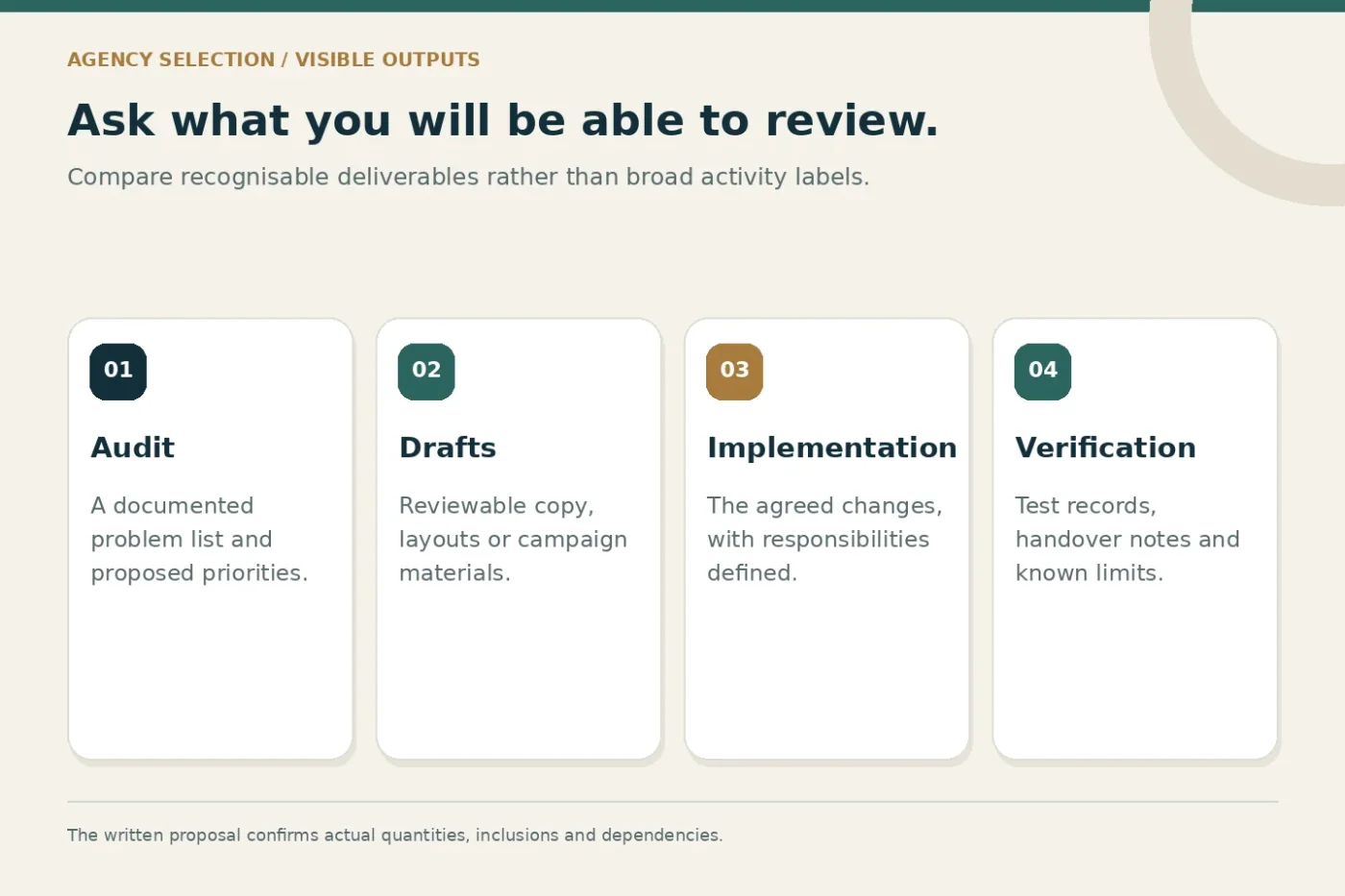
Replace broad labels with visible outputs. Website support could mean a defined page audit and specified repairs. Content support could mean an approved topic plan, written drafts and a publication process. Advertising support needs its own setup, creative and review responsibilities.
Ask how the agency will demonstrate completion. A page inventory, a reviewable draft, a tested form or an organised handover folder can be inspected. A promise to optimise the digital presence is too broad unless the proposal explains the work behind it.
Clarify quantity and boundaries. Define page types, content formats, revision rounds and included channels where relevant. A proposal does not need to predict every future detail, but it should make the first agreed scope clear enough to approve and deliver.
Review examples for relevance and authenticity
Ask what an example actually demonstrates. A design concept shows an approach to visual communication; a delivered project shows work completed in a real context. Neither automatically proves a business outcome. Request the date, scope and limitations needed to interpret any result presented.
Check whether the agency had permission to share the material. Avoid asking for another practice's private information. An anonymised explanation may be appropriate, but the agency should not fill missing evidence with invented identities, figures or endorsements.
Google's people-first content guidance encourages clear information about who created content and why it exists. As a proposal-review principle, ask who will be responsible for the work and how their role will be visible during delivery.
Understand who approves facts and specialist statements
An agency can organise information and prepare communication, but the practice remains the source for its current services, people and operating arrangements. Identify an authorised factual approver before production begins. A missing approval contact can delay otherwise complete work.
Where specialist statements are involved, define the appropriate qualified review separately from a visual or administrative sign-off. Do not assume that a general marketing approval certifies specialist accuracy. The proposal should explain what material the practice must confirm.
Ask how conflicting feedback is handled. One consolidated response is usually easier to implement than separate messages from several people. Agree the route for urgent factual corrections and distinguish those from optional changes to an already-approved creative direction.
Clarify account access and ownership
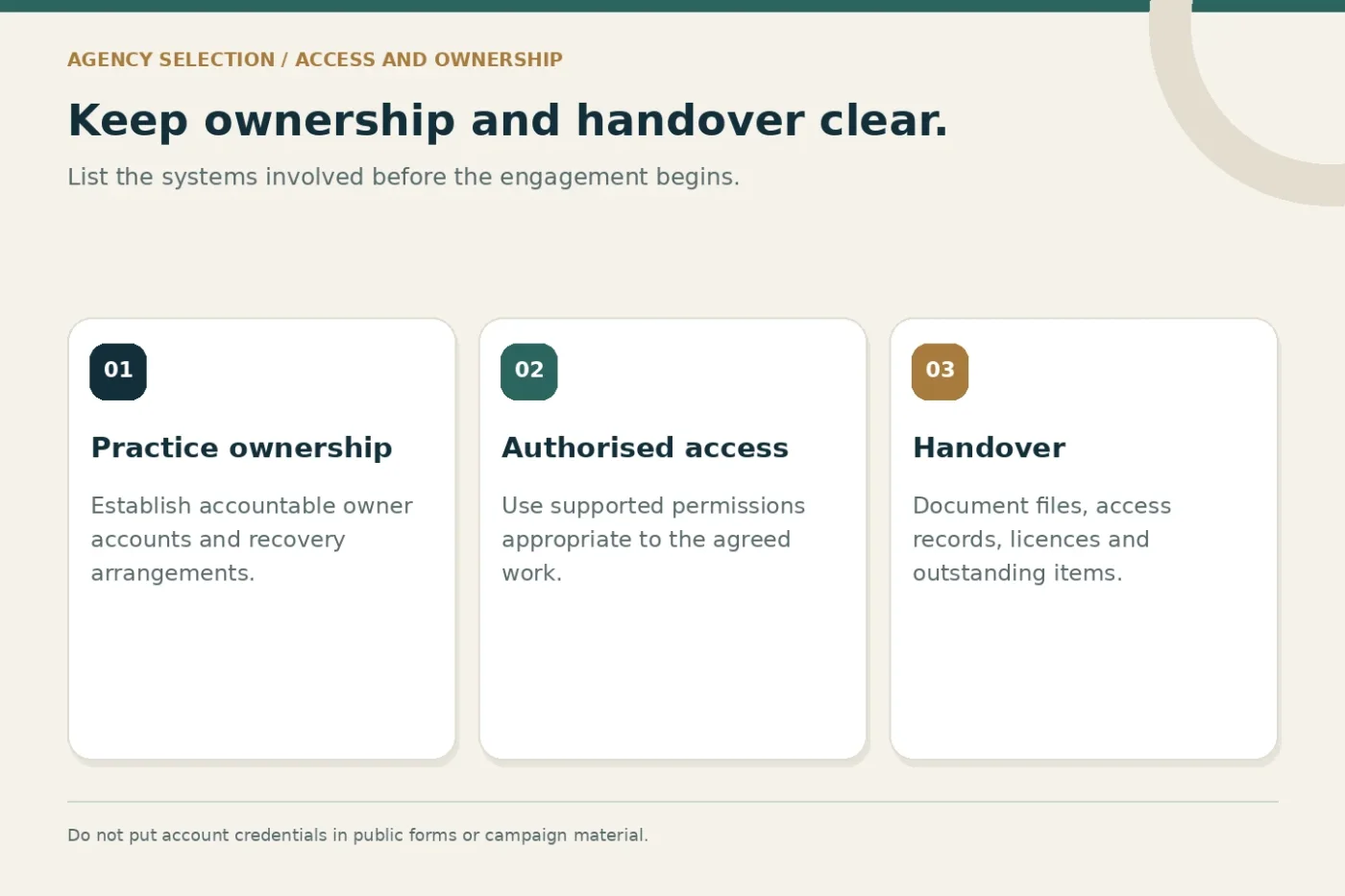
List the systems involved: domain, hosting, website administration, advertising accounts, analytics, social channels and any enquiry tools. Establish who owns each account and how the practice can recover access. Avoid an arrangement where the working relationship depends on one undocumented login.
Use the access methods supported by each service and agree the permissions needed for the work. The practice and agency should understand which changes are authorised. Keep credential sharing out of ordinary enquiry forms and public messages.
Define handover at the beginning. Ask which source files, documentation and account records are included when the engagement ends. Some licences or third-party materials may have their own terms; identify those dependencies before assuming everything can transfer without conditions.
Separate fees, media spend and external costs
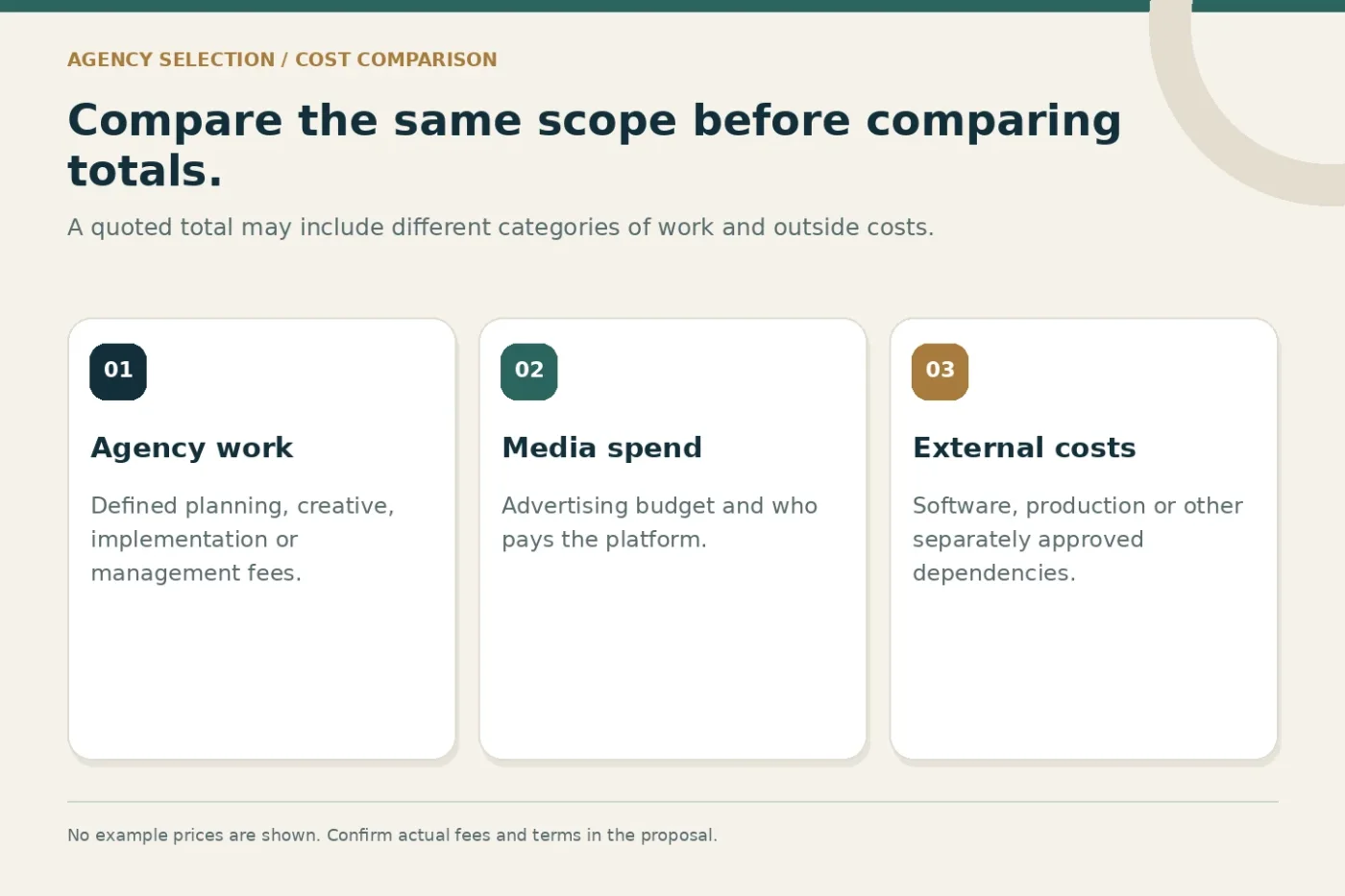
A proposal should distinguish agency work from advertising spend and outside software or production costs. Ask how those costs are approved and who pays the provider. Do not compare two totals until you understand whether they include the same items.
For recurring work, clarify the service period, renewal process and what happens to unfinished items. For a project, define milestones and acceptance criteria. Put changes to the agreed scope in writing so both teams understand the effect on fees and timing.
Avoid selecting solely on the largest deliverable count. A smaller set of useful, approved outputs may be more manageable than a long list of repetitive pages or posts. Evaluate whether the proposed work addresses the problem you identified.
A proposal comparison framework
- Problem
Describe the practical issue and the available baseline.
- Scope
Compare visible deliverables, boundaries and dependencies.
- Responsibility
Assign access, approvals, reporting and handover owners.
- Decision
Approve a written scope and review it against clear criteria.
Ask how reporting will support decisions
Agree the definitions before receiving a dashboard. Website visits, contact clicks, submitted enquiries and staff-confirmed outcomes are not interchangeable. Ask where each measure comes from and whether it is complete enough to support the proposed conclusion.
Google Analytics provides recommended lead-event names, but event naming alone does not establish that a real operational outcome occurred. The agency should explain how website events relate to the practice's enquiry records and where reconciliation is necessary.
A useful report describes the observation, limitations and next proposed action. It should not turn every increase into a success claim or every decrease into a platform explanation without evidence. Ask to see an example of a decision-oriented reporting format.
An illustrative comparison between two scopes
Imagine a fictional clinic receives one proposal for a website refresh and another for ongoing campaign management. The first includes a page audit, approved copy changes and form testing. The second includes advertising setup, creative variations and a reporting routine, but no website development.
Those proposals are not direct alternatives until the clinic decides which problem it needs solved. If the form is broken, campaign management alone may send more visitors into a faulty journey. If the website works but advertising is unmanaged, a visual refresh may not address the immediate need.
A practical decision could be to complete a defined technical repair first and then review a separate campaign scope. This example illustrates sequencing, not a recommendation that every clinic needs both services or a prediction of improved results.
Begin with a manageable engagement
Choose an initial scope your team can support with facts, approvals and staff capacity. Record what is excluded and how later phases would be decided. A clear boundary makes the first review more useful because both sides know what was actually agreed.
Before signing off, ask the agency to restate the trigger, work, review process and handover in plain language. If those points remain unclear, resolve them before paying for an open-ended list of activities. The goal is a working agreement that can guide delivery.
Explore Doctor Promotion's digital marketing services and working approach to identify relevant areas for discussion. The written proposal should confirm the actual selected work, fees and responsibilities rather than relying on a catalogue description alone.
Common questions
Should an agency guarantee rankings or enquiry volume?
Ask for a credible method, defined work and transparent reporting. Treat an unconditional outcome promise cautiously when the result depends on search systems, audiences, competition and the practice's operations.
Can we request a small initial project?
Yes. A defined audit or repair can provide a clearer starting point than committing immediately to every channel. Agree what the project will answer and how the next decision will be made.
Send your main priorities to discuss a proposal built around a practical, reviewable scope.